
The Short Answer
For virtually all modern residential rough-in work, use ball valves. Ball valves are quarter-turn, long-lasting, and provide reliable shutoff after years of sitting open. Gate valves are older technology that have specific commercial and industrial use cases — they are rarely the right choice for new residential or light commercial installations.
That said, understanding why matters. Here’s the full picture.
How Each Valve Works
Ball Valves
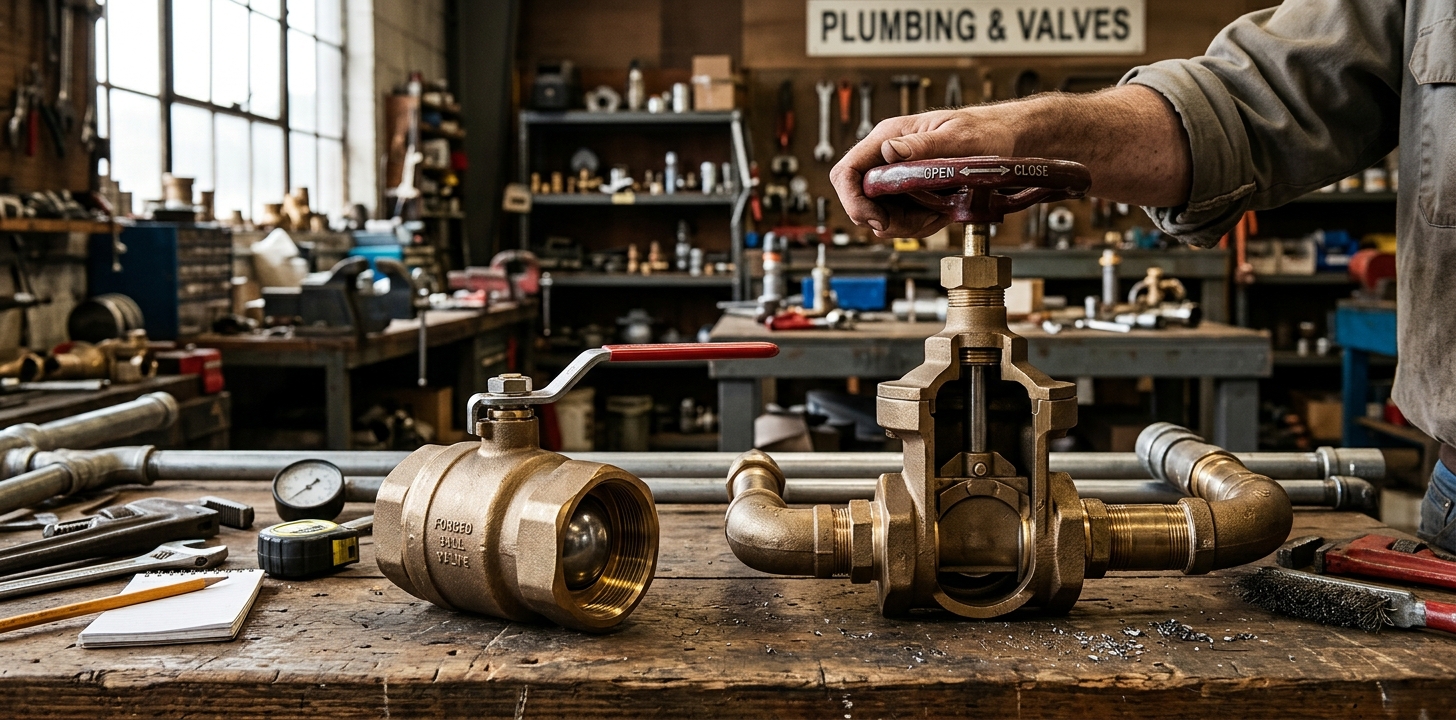
A ball valve uses a drilled sphere (the “ball”) that rotates 90 degrees between open and closed. In the open position, the bore of the ball aligns with the pipe. In the closed position, the solid side of the ball blocks flow.
Key characteristics:
- Quarter-turn open/closed operation
- Full-bore (full-port) or reduced-bore (standard-port) options
- Visual position indicator — handle parallel to pipe = open, perpendicular = closed
- PTFE seats require very little operating torque
Gate Valves
A gate valve uses a wedge-shaped disc (the “gate”) that moves perpendicular to flow by turning a multi-turn stem. To open fully, the gate rises completely out of the flow path. To close, it wedges against the seat.
Key characteristics:
- Multi-turn operation (typically 5–10 full turns to open or close)
- Full bore when fully open — low pressure drop
- No visual open/closed indicator (must count turns)
- Brass or iron wedge seats can corrode and bind over time
Durability and Service Life
This is where ball valves win clearly for most applications.
Gate valves that sit in the open position for years — which is exactly how isolation valves are used — are prone to a specific failure mode: the gate seizes or corrodes in place. When you actually need the valve to close, it won’t. This is a well-documented failure pattern in older residential systems.
Ball valves do not have this problem. The PTFE seats maintain the ball’s ability to rotate even after years of non-operation. A ball valve you installed in 2010 will almost certainly close correctly today. A gate valve from the same era may not.
Pressure Drop Comparison
Full-port ball valves have essentially zero pressure drop in the open position. The bore is the full pipe diameter, and the flow path is straight through.
Standard-port (reduced-port) ball valves have a slightly smaller bore, introducing minor restriction. For supply mains, specify full-port.
Gate valves also have near-zero pressure drop when fully open, which is one reason they remain common in high-flow commercial systems where partial throttling is sometimes needed.
For residential rough-in: Use full-port ball valves. No meaningful difference in flow performance vs. gate valves, with significantly better long-term reliability.
When Gate Valves Are Still Used
Gate valves remain appropriate in a few specific contexts:
- Large-diameter commercial systems where multi-turn control is acceptable and valve bodies are regularly exercised
- Replacement of existing gate valves where changing valve type isn’t practical
- Specific code or authority-having-jurisdiction requirements that specify gate valves
- Irrigation mainlines and raw water systems where non-potable and lower-cost solutions are acceptable
If you’re specifying new rough-in valves for residential or light commercial potable water supply, ball valves are the correct answer.
Product Note
Rough-In’s current catalog is focused on select plumbing and mechanical rough-in products. Contact Rough-In for current product information, document requests, and quote guidance.
Contact Rough-In to discuss volume requirements and lead times.