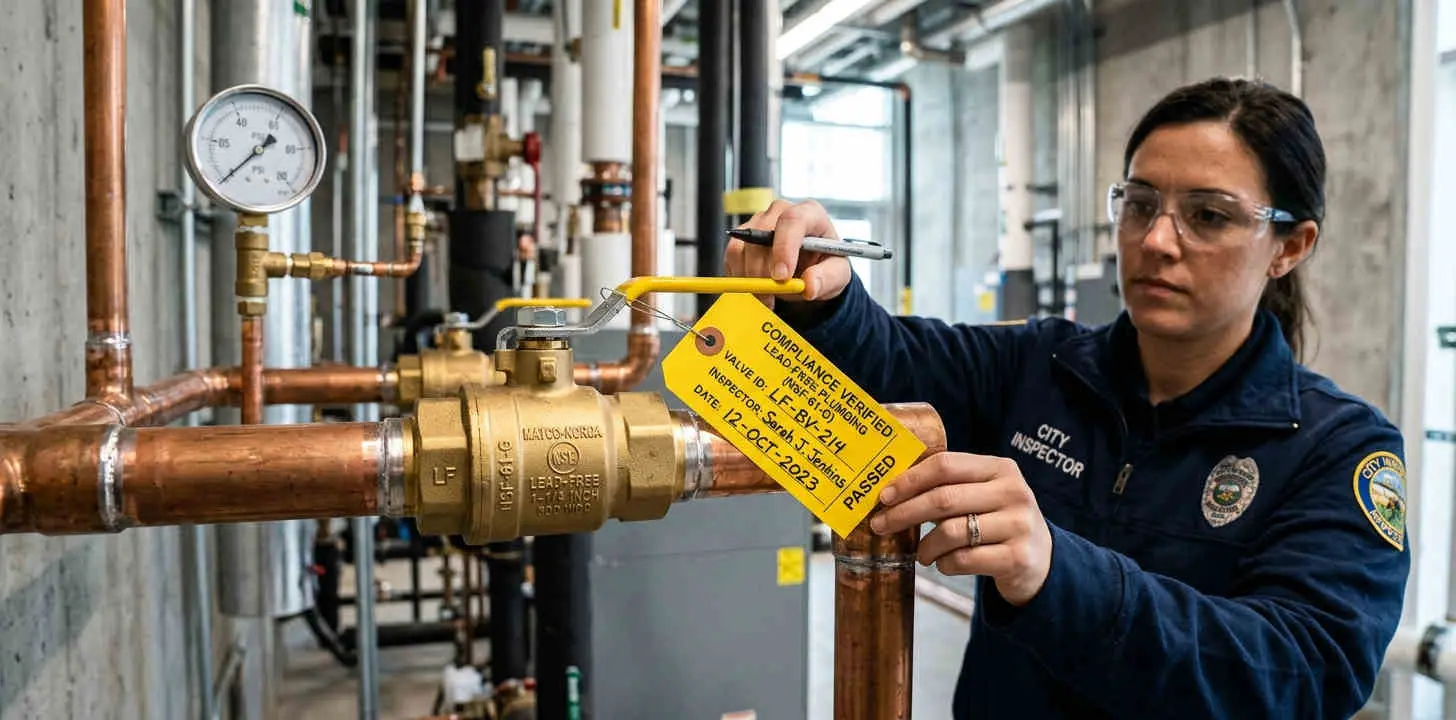
Since the Reduction of Lead in Drinking Water Act took effect in January 2014, all plumbing products that come in contact with potable water must meet a “lead-free” standard — defined as a weighted average lead content of no more than 0.25% across wetted surfaces. This applies to pipes, pipe fittings, plumbing fittings, and fixtures.
Understanding the compliance landscape matters for contractors and procurement teams: the right marking on a spec sheet can be the difference between a passed inspection and a rejected submittal.
The regulatory framework
Federal: The Reduction of Lead in Drinking Water Act (2011, effective 2014)
The federal act amended the Safe Drinking Water Act to tighten the lead-free threshold from 8% to 0.25% (weighted average of wetted component surfaces). It applies to all “pipes, pipe fittings, plumbing fittings, and fixtures” intended for use with potable water.
What it means in practice: Products manufactured after January 4, 2014, for potable water use in the US must meet the 0.25% weighted-average threshold. Products manufactured before that date may still be in supply chain inventory — verify manufacturing date if compliance is critical.
NSF/ANSI 372: The testing standard
NSF 372 is the testing protocol used to verify that a product meets the 0.25% lead-content threshold. NSF is a third-party certification body; a product with NSF 372 certification has been independently tested and verified.
NSF 372 tests the lead content of the product (what it’s made of), not lead leaching into water. It answers the question: “Is the weighted average lead content of all wetted surfaces ≤ 0.25%?”
What to look for on spec sheets: “NSF 372” or “NSF/ANSI 372 certified” — sometimes shown as “Lead-Free per NSF 372.”
NSF/ANSI 61: Separate but related
NSF 61 tests for contaminant leaching — whether the product leaches harmful amounts of lead or other contaminants into the water under simulated use conditions. It is not the same as NSF 372.
A product can be:
- NSF 61 certified (no harmful leaching) but not NSF 372 certified (lead content not independently verified)
- NSF 372 certified (low lead content) but not NSF 61 certified (leaching not tested)
- Both NSF 61 and NSF 372 certified — the most complete compliance picture
For residential and commercial potable water applications in the US, specify products with both NSF 61 and NSF 372 certification.
California AB 1953: The stricter state standard
California’s AB 1953 (effective 2010, tightened further in 2014 to align with the federal 0.25% threshold) applies to all products sold or distributed in California for potable water contact. It uses a different testing methodology than NSF 372.
The key difference: AB 1953 uses a different extraction method and may test different wetted components than NSF 372. A product with NSF 372 certification is not automatically compliant with AB 1953 — manufacturers must specifically test and certify for California.
What to look for: “California AB 1953” or “CA AB 1953 compliant” on the spec sheet or product packaging. Some manufacturers use the shorthand “California lead-free.”
Practical procurement checklist
When procuring potable water plumbing products for a US project:
For most US projects (outside California):
- Product meets NSF/ANSI 372 (≤0.25% weighted average lead)
- Product meets NSF/ANSI 61 (no harmful leaching)
- Manufactured after January 4, 2014 (if source is unclear)
For California projects:
- All of the above, plus:
- Product specifically lists “California AB 1953 compliant” — NSF 372 alone is not sufficient
For school, hospital, or sensitive-population projects:
- Verify whether AHJ (Authority Having Jurisdiction) requires additional documentation
- Request manufacturer’s declaration of conformity, not just spec sheet markings
- Consider specifying NSF 61-G (a new, more comprehensive leaching standard replacing NSF 61 for specific fixture types)
What Rough-In certifies
All Rough-In valves, fittings, and supply stops intended for potable water service carry NSF 61 and NSF 372 certifications. California AB 1953 compliance is noted on spec sheets for products where California compliance has been independently verified.
If you have a submittal requiring specific certification documentation, contact Rough-In with the product number and the specific standard. We can provide manufacturer certification letters and test reports for most products.
Common questions from the field
“The product says ‘lead-free’ on the box but doesn’t show NSF 372. Is it compliant?”
“Lead-free” is a self-declaration. NSF 372 is third-party verified. For regulated projects (most commercial and public work), specify NSF 372 certified, not just “lead-free.”
“We bought fittings from a surplus house. Are they compliant?”
Depends on manufacture date. If fittings were manufactured before January 4, 2014, they may not meet current standards even if sold by a reputable supplier. For critical applications, request the manufacturer’s date code and verify.
“Can I use older-stock valves in a non-potable mechanical system?”
Yes — the lead-free requirements apply specifically to potable water contact. Non-potable mechanical, fire suppression, and other non-drinking-water applications are not subject to the same restrictions. However, label non-potable systems clearly during rough-in.