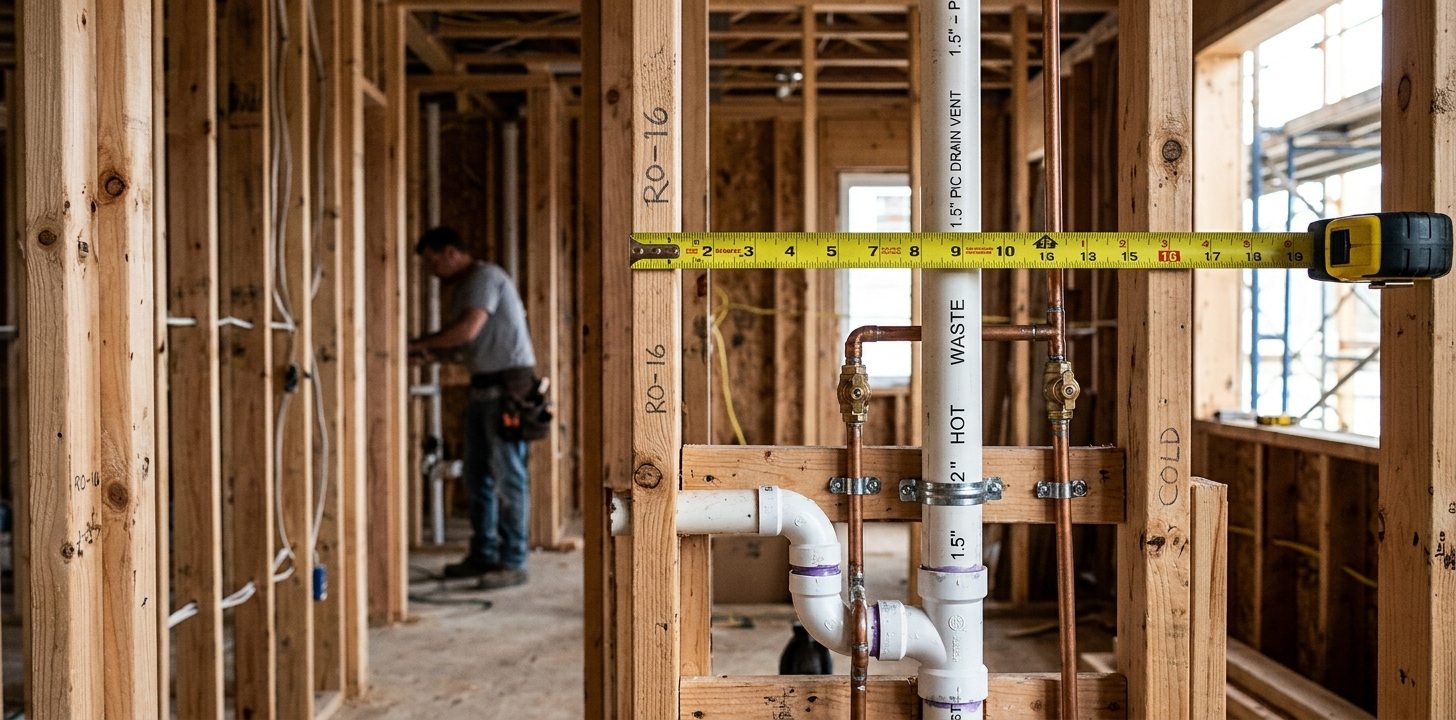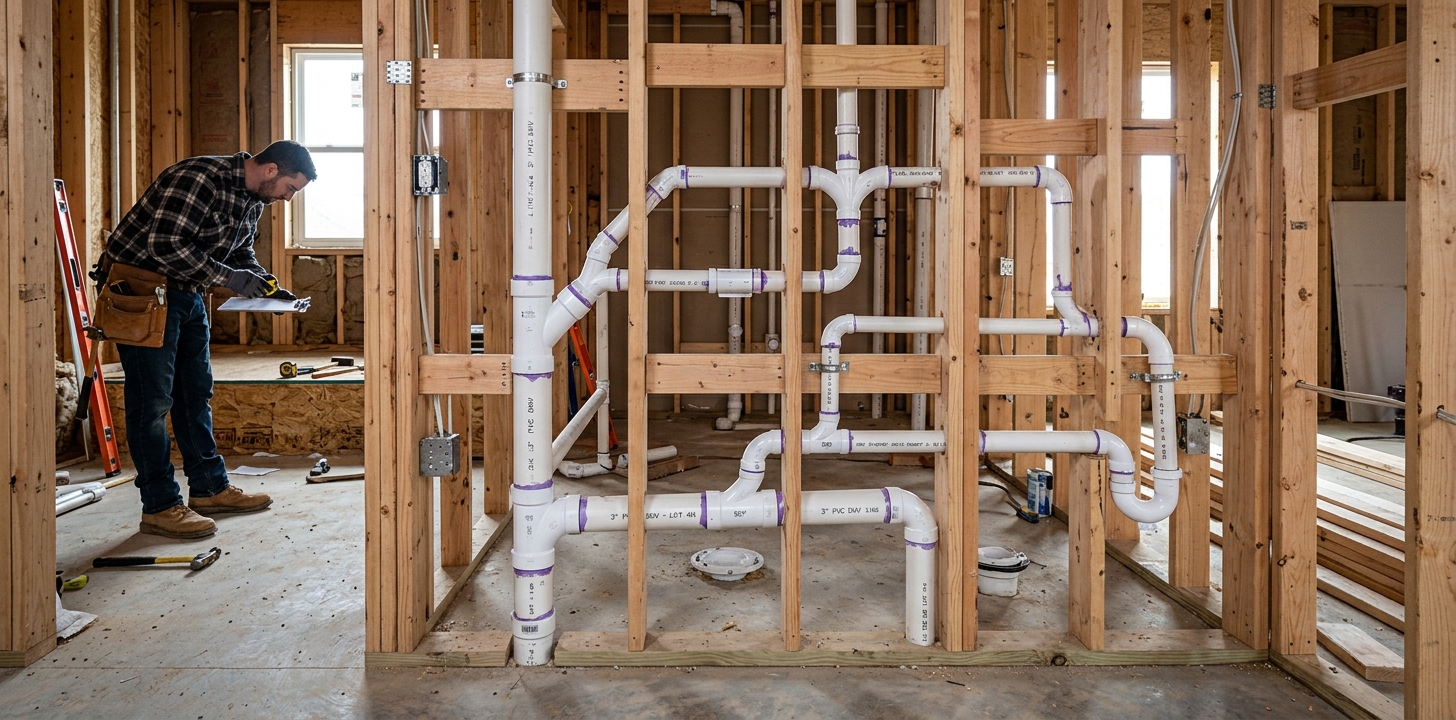
Drain-waste-vent (DWV) systems operate on gravity and air pressure. Get the sizing, slope, or venting wrong and the system drains slowly, gurgles, or allows sewer gas into the building. Unlike supply systems, where a pressure-drop mistake results in reduced flow, a DWV mistake can be invisible during rough-in inspection and only show up as a callback six months later.
This guide covers the three fundamentals every plumber and contractor needs to get right before the walls close.
1. Pipe sizing by fixture unit load
DWV pipe is sized based on drainage fixture units (DFU) — a load-equivalent unit that accounts for both the flow rate and frequency of use for each fixture type.
Fixture unit values (UPC/IPC residential)
| Fixture | DFU load | Minimum trap/drain size |
|---|---|---|
| Lavatory (bathroom sink) | 1 DFU | 1-1/4 in. |
| Bathtub or shower | 2 DFU | 1-1/2 in. |
| Kitchen sink | 2 DFU | 1-1/2 in. |
| Clothes washer | 3 DFU | 2 in. |
| Toilet | 4 DFU (floor-mounted) | 3 in. |
| Floor drain | 2 DFU | 2 in. |
| Dishwasher | 2 DFU (indirect) | 1-1/2 in. |
Branch and stack sizing
A horizontal branch serving multiple fixtures must be sized to handle the total DFU load of all fixtures it serves:
| Branch pipe size | Maximum DFU load (horizontal) |
|---|---|
| 1-1/2 in. | 3 DFU |
| 2 in. | 6 DFU |
| 3 in. | 20 DFU |
| 4 in. | 160 DFU |
Rule of thumb: If a bathroom group (toilet + lavatory + tub/shower) ties into a single branch, that branch must be at least 3 in. — the toilet alone requires a 3 in. drain.
2. Slope
Horizontal drain lines must slope toward the outlet to drain by gravity. The code-required slope is 1/4 in. per foot (approximately 2%) for pipe sizes up to 3 in.
For 4 in. and larger, 1/8 in. per foot (1%) is permitted.
Why slope matters
- Too little slope (under 1/4 in. per foot): Liquid separates from solids. The liquid runs ahead, leaving solids to accumulate and build a clog.
- Too much slope (over 1/2 in. per foot): Liquid outruns solids — same problem, same result.
The target is a “self-scouring” velocity: fast enough to carry solids but not so fast that liquid separates.
Measuring slope during rough-in
A 4 ft. level with a 1 in. standoff (a 1 in. block under the downhill end) creates the visual reference for 1/4 in. per foot slope. More precise: use a digital level set to 2.0°, or use a string line and tape measure — the low end of a 4 ft. run should drop exactly 1 in.
3. Venting
Every trap requires a vent. The vent performs two functions:
- Prevents siphoning — without a vent, a slug of water moving through a drain can siphon the trap water out, leaving the trap empty and allowing sewer gas into the room
- Prevents back pressure — air displaced by flowing drain water needs somewhere to go; without a vent, it pushes back through the nearest trap
Vent types for residential DWV
Individual vent (true vent): Each fixture has its own vent that runs from just downstream of the trap to the vent stack or open air. The most reliable configuration; required by code for toilets in most jurisdictions.
Wet vent: A single pipe serves as both the drain for one fixture and the vent for another. Permitted under specific configurations in UPC and IPC — typically a lavatory wet-venting into a tub/shower drain.
Air admittance valve (AAV): A mechanical device that opens to admit air when the drain is flowing and closes to prevent sewer gas egress. Accepted under IPC in most US states for individual fixture venting. Not accepted by all jurisdictions — check local code before spec’ing AAVs.
Vent sizing rules
Vent pipe must be at least half the diameter of the drain pipe it serves, with a minimum of 1-1/4 in. in most codes.
| Drain size | Minimum vent size |
|---|---|
| 1-1/2 in. | 1-1/4 in. |
| 2 in. | 1-1/4 in. |
| 3 in. | 1-1/2 in. |
| 4 in. | 2 in. |
Vent distance from trap
The horizontal distance from a trap to its vent depends on the drain size and slope:
| Trap and drain size | Max distance to vent (UPC) |
|---|---|
| 1-1/4 in. | 2.5 ft. |
| 1-1/2 in. | 3.5 ft. |
| 2 in. | 5 ft. |
| 3 in. | 6 ft. |
Exceeding these distances increases the risk of siphonage. If a fixture is positioned beyond the maximum distance from a vent stack, it requires its own dedicated vent run.
Common rough-in mistakes and how to avoid them
The missed cleanout
Every change in horizontal direction greater than 45° requires a cleanout within a reasonable access distance. Most inspectors look for cleanouts at the base of each vertical stack and at accessible locations along horizontal runs longer than 40 ft.
Install cleanout adapters with removable plugs (not solvent-cemented caps) during rough-in — it’s much easier to add them now than after the slab is poured or the walls are closed.
Wrong trap depth
A trap must maintain a minimum 2 in. water seal. Deep-seal traps (4 in.) are required for floor drains subject to evaporation in areas that are infrequently used.
Install floor drains with a trap primer connection in mechanical rooms that won’t see regular foot traffic — primer feeds water periodically to maintain the seal.
The reversed sanitary tee
A sanitary tee (also called a “sanitary T”) is directional — it’s designed to direct flow from a horizontal branch into a vertical stack. Installing it in the wrong orientation (trying to use it as a horizontal wye) creates a scooping effect that traps solids.
For horizontal-to-horizontal connections, use a wye and 1/8 bend. Reserve sanitary tees for horizontal-to-vertical transitions only.
Rough-in checklist
Before closing walls or pouring slab:
- All horizontal branches slope 1/4 in. per foot toward the outlet
- Branch sizes accommodate total DFU load of all connected fixtures
- Each trap has a vent within code-required distance
- Vent pipes are minimum 1-1/4 in. or half the drain diameter
- Cleanouts installed at stack bases and direction changes
- Floor drains have integral trap or separate trap with primer connection
- All connections made with correct fitting type (no tees on horizontal runs)
- Water test or air test completed before concealment