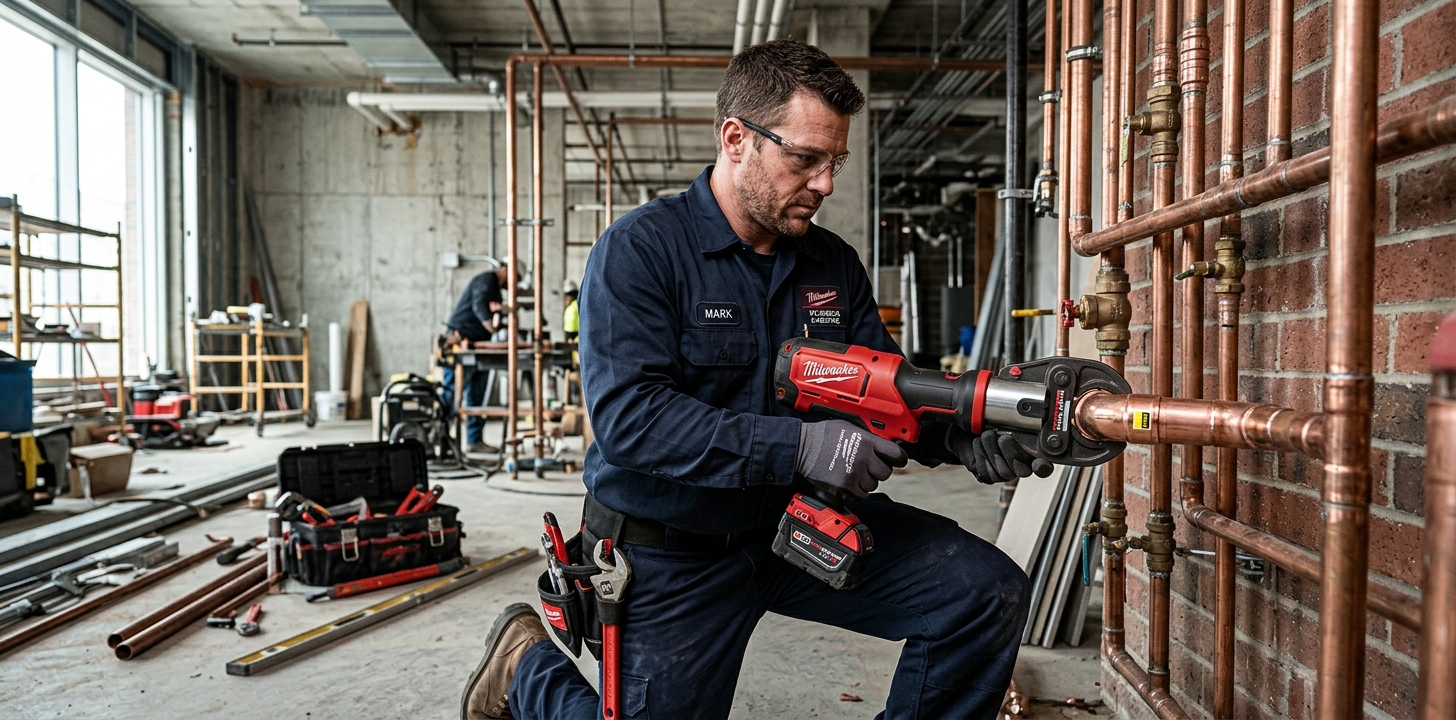
Press fitting systems — where a hydraulic or battery-powered tool permanently crimps a fitting sleeve onto the pipe — have become the dominant connection method on commercial projects and are growing rapidly in larger residential work. The labor savings are real: a press joint takes under 10 seconds versus 2–4 minutes for a sweat joint, with no torch, no flux, and no hot-work permits required.
But press systems have failure modes that sweat doesn’t. Understanding the system before you specify it saves expensive callbacks.
How press fittings work
A press fitting has a fitting body (usually copper, brass, or stainless) with a sleeve (or “ring”) that sits over the connection point. The fitting body is inserted into the pipe, and the press tool squeezes the sleeve down onto the fitting body and pipe, creating a permanent mechanical-and-seal joint.
The seal is provided by an O-ring inside the fitting — compressed between the pipe OD and the fitting body ID during the press cycle. Most manufacturers use EPDM O-rings as the default seal, with FKM (Viton) available for higher-temperature or chemical-resistance applications.
The “unpressed fitting” problem
Press fittings have an intentional leak path when unpressed. If a fitting is installed and the tool is not applied — because it was missed, because the tool ran out of battery, or because someone forgot — it will leak at operating pressure.
This is a designed feature, not a defect: it prevents unpressed joints from hiding in the walls. An unpressed joint leaks during pressure test, which reveals it before close-in.
The risk: Unpressed joints that are not reached by the pressure test (isolated branches, capped lines) can end up closed in and leak later. Always ensure every press joint is included in the pressure test boundary.
System compatibility: the critical constraint
Press fitting systems are not universally cross-compatible. Three major systems dominate the US market:
| System | Profile | O-ring color (EPDM) | Notes |
|---|---|---|---|
| Viega MegaPress / ProPress | M-profile | Green | Most common in US |
| NIBCO Press | NIBCO-proprietary | Red | Tool-compatible with Viega for copper |
| Milwaukee PressConnect | Milwaukee-profile | Black | Tool only; fits Viega M-profile fittings |
| Ridgid RP | Compatible with Viega M-profile fittings | — | Tool interoperability with Viega |
The rule: Press tools from different manufacturers may or may not be compatible with fittings from different manufacturers. The fitting profile (the shape of the press jaw engagement) determines compatibility — and profiles differ between manufacturers.
For copper press systems, Viega ProPress and similar M-profile systems have the widest tool interoperability. Always verify fitting-to-tool compatibility before starting a job.
When press makes sense
Situations where press is the right choice
Commercial and multi-unit residential: No torch permits, faster labor, consistent joint quality regardless of pipe moisture or ambient temperature. On a 20-unit project, the labor savings typically justify the tooling investment or rental cost.
Retrofit work: Press doesn’t require dry pipe the way sweat does. On a live building with residual moisture in the lines, press is much more practical.
Concealed mechanical spaces: No combustion products, no charred framing, no fire watch required. Insurers and GCs on commercial jobs increasingly require press or push-to-connect over torch work.
High-pressure or large-diameter systems: Press valves and couplings are available in sizes up to 4 in., handling pressures that would make PEX impractical. For commercial mechanical rooms and main distribution runs, press copper is often the fastest compliant option.
Situations where press is the wrong choice
Residential branch lines under 1/2 in.: Press tooling at 1/2 in. is straightforward, but the labor savings versus crimp PEX are minimal. Most residential branch work (1/2 in. to 3/4 in.) is faster and cheaper with PEX crimp.
Retrofit with unknown pipe condition: Press requires consistent OD and a smooth pipe surface within the engagement zone. Old steel pipe or severely corroded copper with pitting in the press zone will not form a reliable joint. In these cases, mechanical couplings or cut-and-replace with threaded fittings may be more appropriate.
Extreme high-temperature loops: EPDM O-rings are rated to approximately 250°F continuous. For steam or high-temperature hot water above this range, press fittings are not appropriate.
Valve selection for press systems
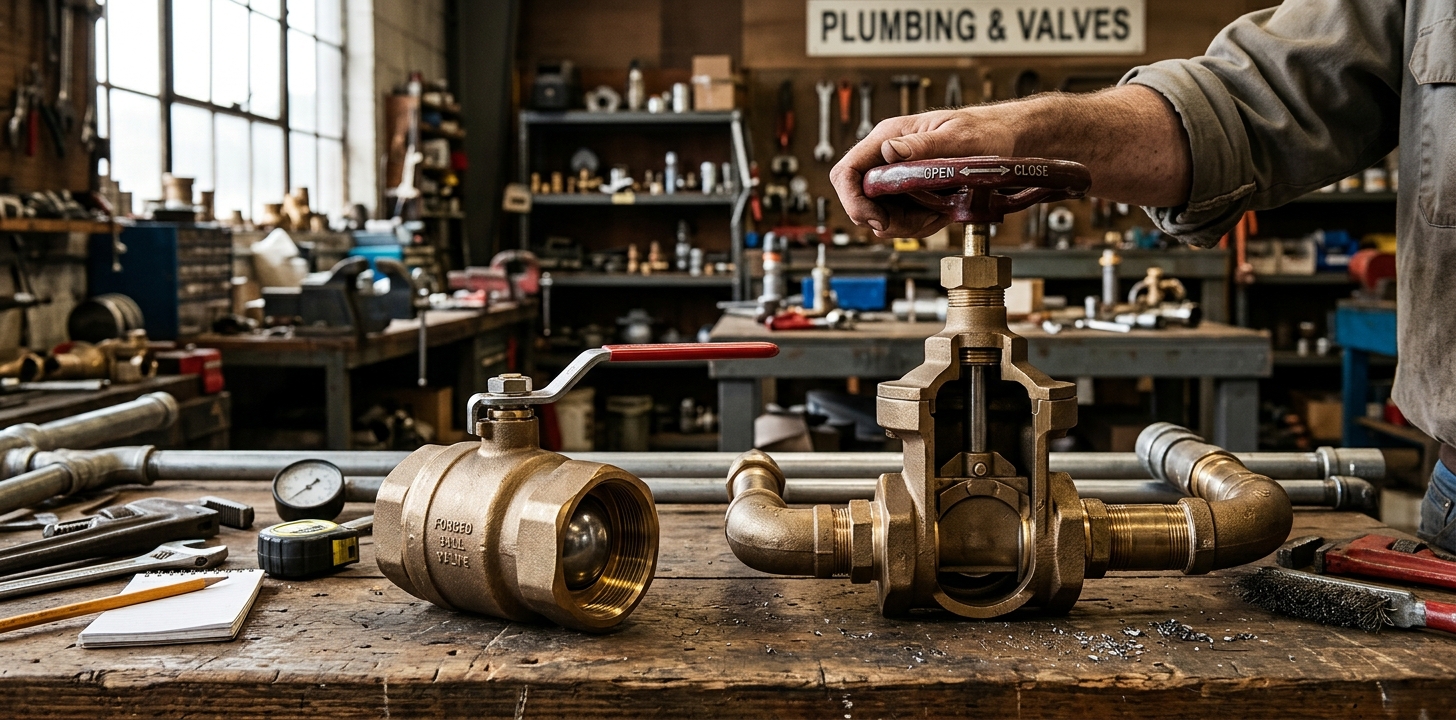
Press ball valves are available in the same fitting profiles as press couplings and should be sourced from the same manufacturer (or a verified compatible supplier) to ensure jaw compatibility.
Key things to verify on press valve spec sheets:
- Fitting profile — must match your press tool jaw
- O-ring material — EPDM default; specify FKM for elevated temperature
- Pressure rating — verify at your operating temperature, not just ambient
- Certification — NSF 61 for potable water; confirm low-lead (NSF 372 or AB 1953) for California jobs
Rough-In’s current catalog is focused on select plumbing and mechanical rough-in products. Contact Rough-In before ordering to confirm current product information and documentation.
Purchasing and procurement notes for distributors
Press fittings are typically sold in bags of 10 or 25 per size. For large commercial jobs, case quantities are common.
Key purchasing considerations:
- O-ring material — specify EPDM (default) or FKM at order time; they are not field-swappable
- Lead time on large sizes — 2 in.+ press fittings and valves often have longer lead times than 1/2–1 in.; build this into the project schedule
- Tooling availability — Rough-In can coordinate with tool rental or tooling procurement alongside fitting orders for large projects
Contact Rough-In with your press system type, sizes, and quantities for project pricing.